
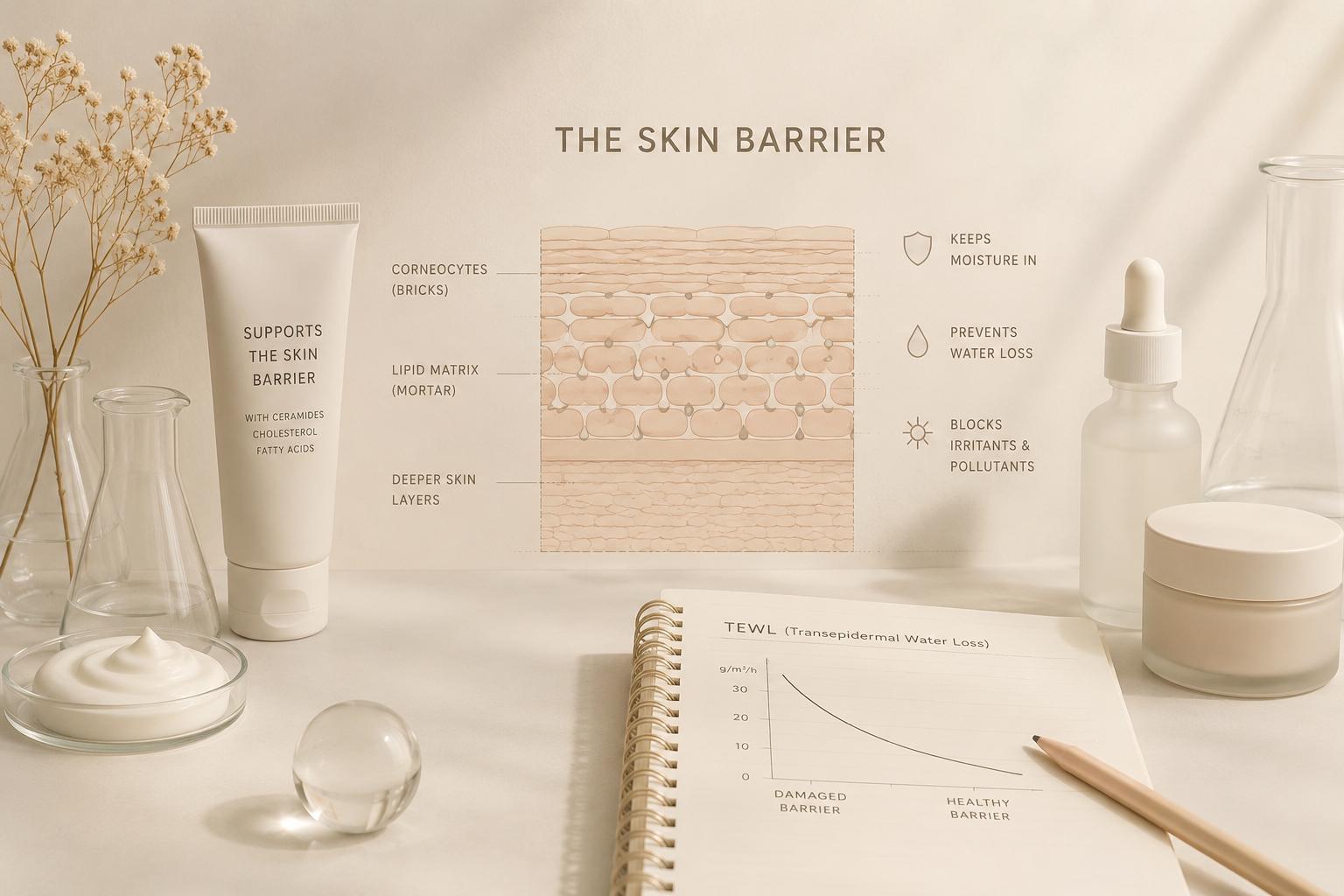
Few skincare concepts have become as prominent in recent years as the “skin barrier.” The phrase appears on cleansers, moisturizers, serums, masks, and even makeup products. Brands promise to “support,” “strengthen,” “protect,” or “repair” the barrier, often presenting it as the solution to dryness, sensitivity, redness, and irritation.
Yet despite its popularity, the term is often used without much explanation. The skin barrier is not simply a marketing concept — it refers to a real biological structure with measurable functions. Understanding where the science ends and where the marketing begins is essential for interpreting these increasingly common claims.
What the Skin Barrier Actually Is ?
In dermatology, the term “skin barrier” generally refers to the stratum corneum, the outermost layer of the epidermis. This layer is often described using the “bricks and mortar” model. The “bricks” are corneocytes, which are flattened dead skin cells, while the “mortar” consists of a complex lipid matrix primarily made up of ceramides, cholesterol, and free fatty acids.
Together, these components perform two critical functions. First, they help prevent excessive water loss from the body. Second, they act as a protective shield against environmental irritants, allergens, pollutants, and microorganisms.
The barrier also depends on multiple structural proteins, including filaggrin, loricrin, and corneodesmosin. Research has shown that disruptions in these proteins can contribute to impaired barrier function and are associated with conditions such as atopic dermatitis and psoriasis.
In other words, the skin barrier is not a single structure that can be “fixed” through one ingredient alone. It is a complex biological system involving lipids, cells, proteins, hydration levels, and ongoing biological processes.
How Scientists Evaluate Barrier Function ?
Unlike many skincare concepts that remain difficult to measure objectively, skin barrier function can be evaluated through several established scientific methods.
One of the most widely used measurements is transepidermal water loss (TEWL), which measures the amount of water that evaporates through the skin. When the barrier is functioning properly, water loss remains relatively low. When the barrier is damaged or disrupted, TEWL generally increases.
However, TEWL is not the only tool researchers use. Other assessments may include skin hydration measurements, evaluation of lipid organization within the stratum corneum, clinical observations of dryness and irritation, and, in some research settings, analysis of inflammatory markers.
This distinction matters because it highlights an important point: claims about supporting or improving the skin barrier are, at least in principle, testable through measurable outcomes rather than subjective impressions alone.
The Difference Between Ingredient Evidence and Product Evidence
One of the most important distinctions in skincare marketing is the difference between evidence supporting an ingredient and evidence supporting a finished product.
Ceramides, cholesterol, and fatty acids are well-established components of the skin’s natural barrier system. Their biological relevance is not controversial. A growing body of research suggests that formulations containing these ingredients may help support barrier function under certain conditions.
However, the presence of a scientifically supported ingredient does not automatically prove that the final product delivers clinically meaningful results.
A finished product’s performance depends on multiple factors, including ingredient concentration, formulation design, stability, delivery system, interactions between ingredients, and how the product is used in real-world conditions.
As a result, a moisturizer that contains ceramides is not necessarily equivalent to a moisturizer that has demonstrated measurable improvements in barrier-related outcomes through clinical testing.
Why “Repair” and “Support” Aren’t Just Stylistic Choices
The choice between softer language like “supports the skin barrier” and stronger language like “repairs” or “restores” the barrier isn’t only a marketing decision — it’s also shaped by regulatory exposure. In most markets, claims that suggest a product treats, heals, or repairs a bodily function move closer to a therapeutic or drug-like claim, which invites significantly more regulatory scrutiny than a general cosmetic claim. “Supports” is vaguer, but that vagueness also keeps it further from a claim regulators would require clinical evidence to back up. This doesn’t mean every brand using “repair” is making an unsubstantiated claim, or that every brand using “supports” is being deliberately cautious — but it does mean word choice in barrier marketing likely reflects legal risk management as much as it reflects marketing strategy alone.
Why Barrier Marketing Has Become So Popular
The rise of barrier-focused marketing reflects broader changes within the skincare industry.
Over the past decade, consumers have been exposed to increasingly active-focused routines featuring exfoliating acids, retinoids, peels, and intensive treatment products. At the same time, discussions around irritation, sensitivity, over-exfoliation, and compromised skin have become more common across social media and skincare communities.
Against this backdrop, barrier support emerged as a compelling message. It offers a framework that connects multiple consumer concerns — dryness, redness, discomfort, sensitivity, and recovery from aggressive routines — under a single concept.
The popularity of barrier marketing therefore reflects both legitimate scientific concerns and evolving consumer behavior. It is not simply a manufactured trend, but neither does its popularity automatically validate every claim attached to it.
Where Marketing Language Becomes Less Clear
The strongest scientific support often exists for statements such as “contains ingredients associated with barrier function” or “formulated with ceramides and fatty acids.”
The language becomes less straightforward when products claim to “repair,” “restore,” or significantly improve the barrier without publicly available evidence demonstrating those outcomes.
Importantly, the absence of published clinical data does not necessarily mean a product is ineffective. Clinical testing can be expensive, and many companies do not publish all internal research. Some brands may possess data that is not publicly available, while others may rely primarily on ingredient-level evidence when making claims.
For consumers, this creates a challenge. In many cases, it is difficult to determine whether a barrier-related claim reflects direct testing of the finished product or simply the inclusion of barrier-associated ingredients.
What Consumers Can Take Away
The practical takeaway is not that barrier-related claims should be dismissed. Barrier function is a legitimate area of dermatological research, and ingredients such as ceramides, cholesterol, fatty acids, glycerin, and certain humectants have well-established roles in supporting skin health.
At the same time, consumers should recognize that phrases such as “supports the skin barrier” are often broad marketing statements rather than guarantees of clinically proven outcomes.
Looking beyond the front-of-pack claim and examining the formulation, ingredient profile, and available evidence can provide a clearer picture of what a product is likely to deliver.
For individuals with medically significant barrier dysfunction, including conditions such as atopic dermatitis, professional medical guidance remains more reliable than generalized marketing language.
NBMakeup Perspective
The growing emphasis on skin barrier support reveals a larger shift within the beauty industry. For years, skincare marketing focused heavily on transformation — stronger actives, faster results, and increasingly intensive routines. Today’s barrier-focused messaging suggests a different consumer priority: maintaining skin comfort, resilience, and long-term tolerance.
Whether this represents a lasting industry shift or simply the next stage of skincare marketing remains uncertain. What is clear is that “skin barrier” has evolved from a dermatological concept into one of the industry’s most influential marketing narratives — and understanding the science behind that narrative has never been more important.
Sources :
- Journal of Drugs in Dermatology — “Skin Barrier Health: Regulation and Repair of the Stratum Corneum and the Role of Over-the-Counter Skin Care”
- Frontiers in Medicine — “Systematic characterization of the barrier function of diverse ex vivo models of damaged human skin” (2024)
- Advances in Wound Care — “Clinical Measurement of Transepidermal Water Loss”
- PMC — “Clinical Measurement of Transepidermal Water Loss”

No comment