
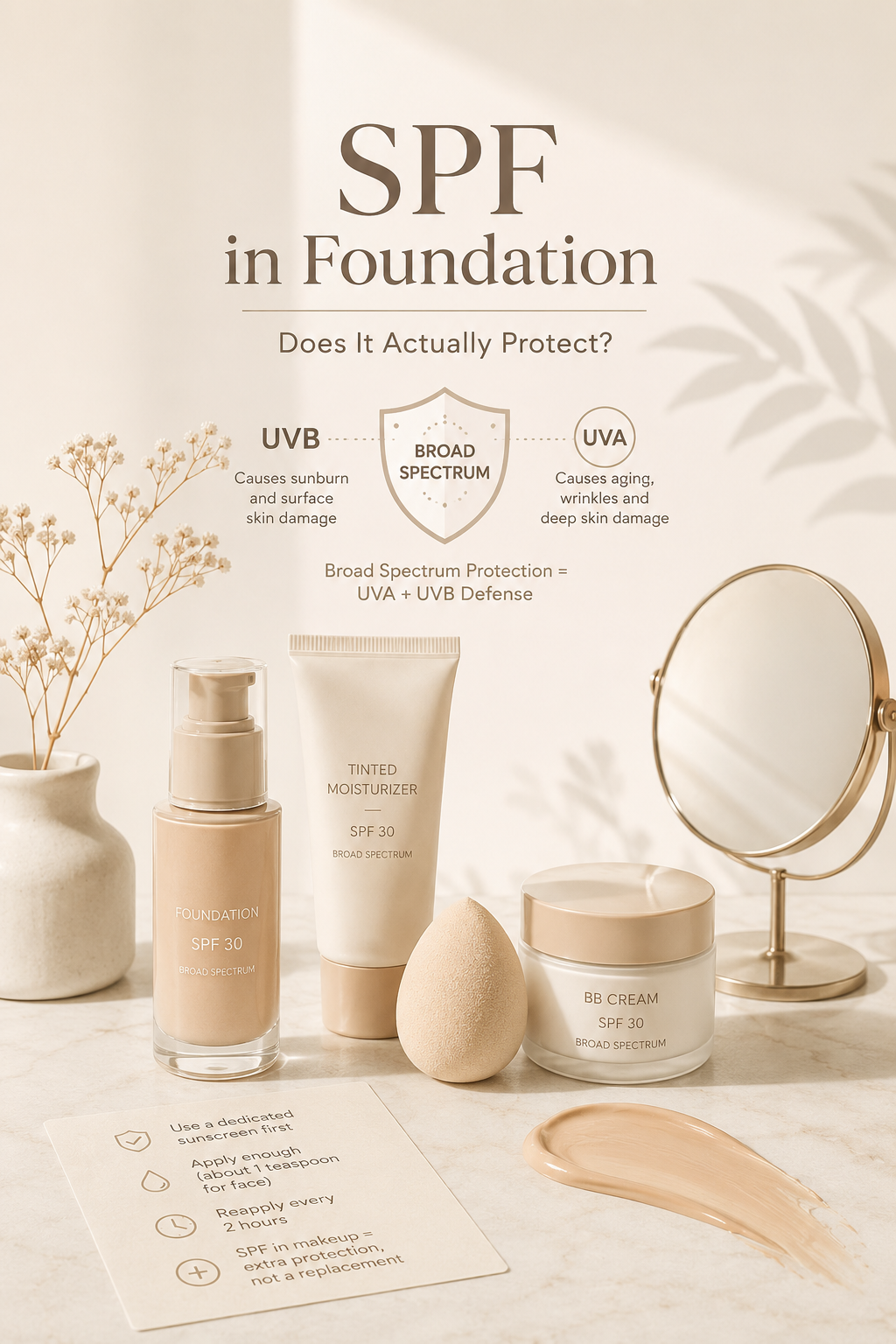
Foundation, tinted moisturizer, and BB cream with a built-in SPF rating have become some of the most common “multitasking” products in beauty. The appeal is obvious: one product, two functions, and one less step in a daily routine.
But dermatologists and regulatory testing standards point to a consistent gap between the SPF number printed on the label and the protection most people actually receive when they wear these products as makeup.
- How SPF Numbers Are Actually Tested
The SPF value on any product—whether it’s a sunscreen or a foundation—is not a theoretical estimate. In the United States, SPF is determined through a standardized clinical test defined by the FDA.
During testing, the product is applied at a density of 2 milligrams per square centimeter of skin, spread as evenly as possible using a controlled application method before UV exposure is measured. This testing amount is intentionally generous and is typically much thicker than how most consumers apply face products in everyday life.
That detail is at the center of the issue: the SPF number reflects protection achieved at the tested application thickness—not necessarily the protection achieved under real-world conditions.
- Understanding UVB, UVA, and SPF
To understand why this matters, it’s important to distinguish between different types of ultraviolet radiation.
UVB rays are primarily responsible for sunburn and are the main focus of SPF testing. An SPF value indicates how effectively a product protects against UVB-induced skin damage.
UVA rays, on the other hand, penetrate deeper into the skin and are associated with photoaging, wrinkles, collagen breakdown, and some forms of skin cancer. UVA exposure can occur throughout the day and can penetrate window glass more effectively than UVB.
This is why dermatologists typically recommend using a broad-spectrum sunscreen, which is designed to provide protection against both UVA and UVB radiation. A high SPF number alone does not necessarily guarantee strong UVA protection.
- Why Real-World Application Falls Short
Foundation is generally applied much more thinly—and often less evenly—than the amount used during SPF testing. The goal of foundation is usually cosmetic coverage and a natural-looking finish, not maximum product volume.
Dermatologists frequently note that applying enough foundation to achieve its labeled SPF would often result in a visibly heavy or cakey appearance, making it impractical for everyday makeup use.
As a result, the actual protection received may be substantially lower than the labeled SPF value, simply because consumers typically apply only a fraction of the amount used during laboratory testing.
Coverage area creates another challenge. Foundation is often applied only where coverage is desired, leaving areas such as the hairline, ears, neck, eyelids, and sometimes the jawline less protected or completely uncovered. These are also areas that can experience significant cumulative UV exposure over time.
- So Is SPF in Foundation Worthless?
Not necessarily.
A common mistake is to swing from one extreme to the other—from assuming SPF foundation can replace sunscreen to assuming it provides no meaningful benefit at all.
The reality is more nuanced.
Foundation containing SPF can still provide additional protection when worn over a properly applied sunscreen, particularly during everyday incidental exposure such as commuting, short walks, or time spent near windows.
Mineral-based formulas that contain ingredients such as zinc oxide or titanium dioxide continue to provide some UV-blocking properties even when applied more thinly than the amount used in SPF testing. However, the level of protection may not match the SPF value displayed on the packaging.
Some formulations also contain iron oxides, which may help reduce visible-light-induced hyperpigmentation, particularly in individuals prone to conditions such as melasma or post-inflammatory hyperpigmentation. This benefit is separate from traditional UVB protection and is not fully reflected in standard SPF testing.
The distinction most dermatologists make is not that SPF foundation is useless—it’s that SPF-containing makeup should not be relied upon as the primary or sole form of sun protection, especially during prolonged outdoor exposure.
- What This Means in Practice
The most consistent recommendation across dermatology organizations is to apply a dedicated broad-spectrum sunscreen with SPF 30 or higher as a separate step before makeup.
SPF-containing foundation can then serve as an additional protective layer rather than a replacement for sunscreen.
For extended outdoor exposure, reapplication also remains important. Most sunscreens are recommended to be reapplied approximately every two hours during continued sun exposure. Because reapplying traditional sunscreen over a full face of makeup can be difficult, products such as SPF mists or powders may offer a more practical option for touch-ups—although they may not always provide protection equivalent to a freshly applied sunscreen layer.
- NBMakeup Verdict
SPF in foundation is best viewed as a bonus layer of protection, not a substitute for sunscreen.
The SPF number on the label is measured under controlled conditions using far more product than most people apply in daily life. While SPF-containing makeup can contribute meaningful additional protection, especially for incidental exposure, achieving reliable protection against both UVA and UVB radiation still depends on using a dedicated broad-spectrum sunscreen as the foundation of a sun-protection routine.
- Sources


No comment