
NBMakeup Insight
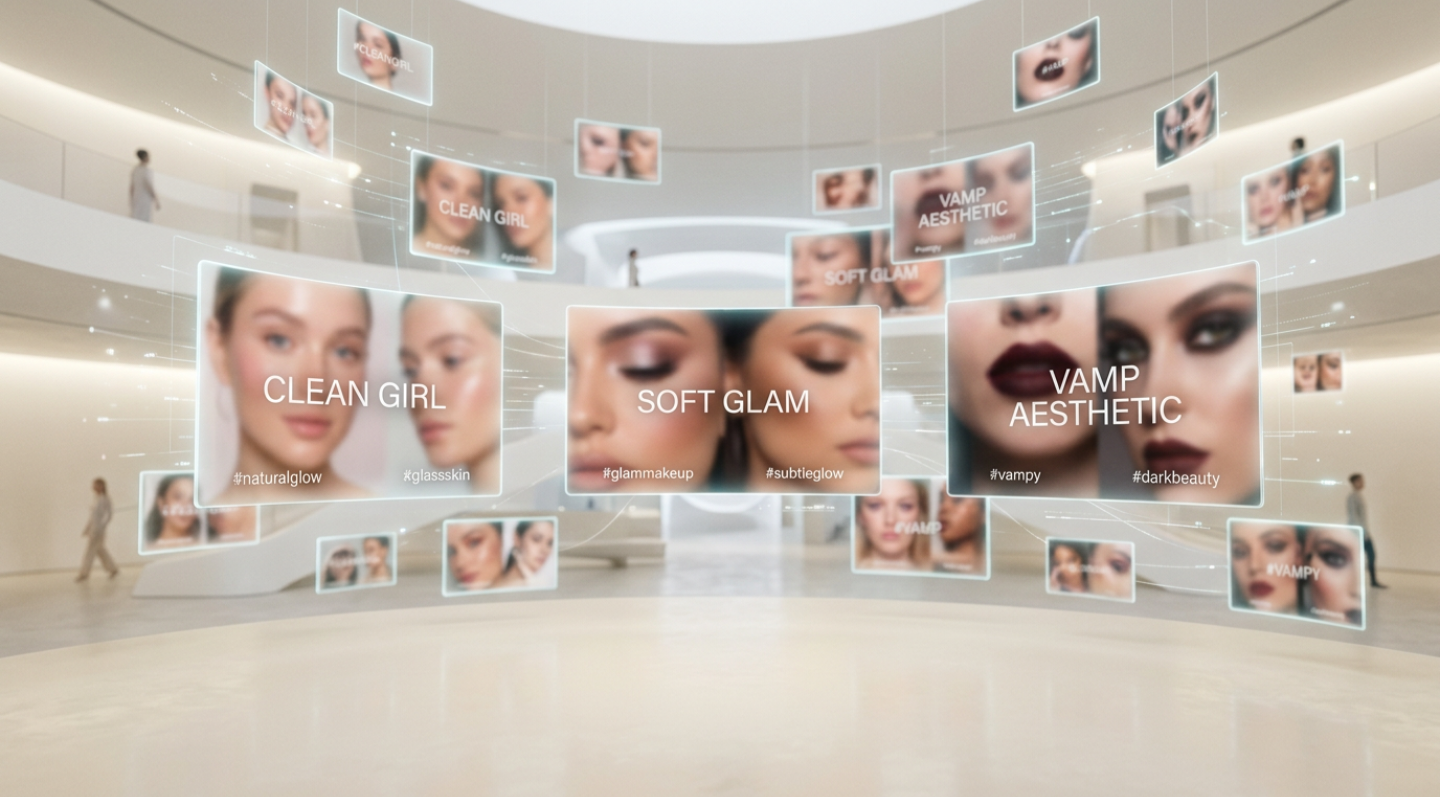
Before TikTok, a beauty trend could dominate for years. Today the same aesthetic can rise and disappear within weeks — clean girl, latte makeup, mob wife glam, siren eyes . That shift isn’t a vibe. It’s the outcome of five specific mechanisms, and each one is documented.
1. Algorithms Are Built to Reward Novelty, Not Consistency
Short-form platforms distribute content based on engagement signals, and engagement drops when the same format repeats too often. Industry coverage of the beauty category specifically confirms this loop: a creator posts a technique, the algorithm amplifies variations that spark discussion, and brands respond — sometimes restocking or reformulating within weeks — before the cycle moves to the next thing . A 2025 academic review of TikTok’s role in “fast beauty” marketing found the same pattern from the research side: AI-driven personalization increases exposure to a trend quickly, but that same personalization engine is what accelerates the churn to the next one .
There’s also a hard data point worth noting: Google Trends search interest for “skincare products tiktok” spiked to a peak of 87 in September 2025, then dropped to 19 by December — a roughly 78% collapse in four months . That’s not a slow fade. That’s the algorithm’s novelty bias showing up directly in consumer search behavior.
2. The Distribution Path Got Shorter — So Did the Trend’s Lifespan
The old path was runway → magazine → celebrity → consumer, with each stage adding weeks or months of lag. Business of Fashion’s beauty coverage describes the current pipeline as compressed and direct: a single viral moment (their example is snail mucin serum) can push an entire product category into the mainstream almost immediately — but that same speed means beauty trends are now, in their words, becoming more ephemeral and increasingly unpredictable . A shorter path to virality is mechanically also a shorter path to saturation.
3. Brands Don’t Just Follow Trends — They Manufacture Them
It’s tempting to think brands simply react to what’s organic. Current marketing-industry reporting says otherwise: beauty brands are now formally building multi-tier creator programs — micro-influencers for volume, expert partners for credibility — specifically so that when ten creators interpret one brief, several will reliably catch on . Micro-trends are increasingly used as low-cost market tests before a bigger product launch . This is coordinated demand generation, not passive trend-following.
4. The Beauty Economy Needs This Speed to Keep Growing
McKinsey’s 2025 State of Beauty report is the most useful source here because it complicates the story rather than confirming it neatly: the industry grew at 7% annually from 2022–2024 on what McKinsey describes as an “insatiable appetite for newness,” but that growth is now colliding with market saturation, meaning the same trend-churn model that fueled growth is starting to show diminishing returns . In other words — fast trend cycles were an effective growth engine for a few years, but the data suggests the model is now hitting a ceiling, not accelerating indefinitely. That’s a more honest and more useful takeaway than “brands need speed to survive.”
There’s a consumer cost to this too: coverage of TikTok beauty culture points to significant year-over-year spending on trend-driven products that people use only briefly before abandoning them, alongside real concern about overconsumption .
5. Trend Fatigue Is a Measurable Psychological Response, Not Just a Feeling
This part has the strongest scientific backing of the whole piece. Habituation — the well-documented process by which the brain reduces its response to a repeated stimulus — is a basic feature of how attention works, and it applies to media exposure the same way it applies to a smell or a sound: the first exposure captures attention, and each repeat produces less response, a pattern marketers call “ad fatigue” once it shows up in engagement metrics . Applied specifically to social trends, a 2022 Pew Research survey found that a majority of social media users report feeling overwhelmed by how fast online trends move, and a large share said they felt frustrated when something they’d just adopted was already outdated . That’s the mechanism behind why a still-attractive aesthetic gets abandoned — not because it stopped looking good, but because repeated exposure measurably reduces the brain’s response to it.
6. Is Taste Actually Changing — Or Just What Gets Rewarded?
This is the most interesting and least settled question, and it’s worth presenting both sides honestly rather than picking the tidier answer.
One industry perspective, voiced by The Future Laboratory’s Christopher Sanderson at the 2025 Beauty Inc Catalysts conference, argues the opposite of “taste is stable, only display changes”: he contends that algorithmic content patterns are actively narrowing what beauty looks like, producing more visual sameness despite more cultural diversity than ever — and that consumers are starting to push back, craving beauty that feels less engineered . That’s a direct challenge to the idea that people’s underlying preferences haven’t shifted.
At the same time, other coverage of the same platform dynamics reports the opposite directional pull: TikTok has pushed beauty toward softer, more natural aesthetics, with younger consumers specifically rejecting the older, more sculpted “Instagram face” look in favor of individuality .
Both can’t be fully right at once, and neither is backed by hard longitudinal data on actual taste (as opposed to what’s visible online) — which is the honest caveat: nobody has good data separating “taste changed” from “what gets algorithmic distribution changed.” Anyone who tells you this question is settled is oversimplifying.
What This Means
Fast trend cycles in beauty are the product of at least four converging systems: algorithmic distribution that rewards novelty, a compressed content pipeline, brand strategies that manufacture demand deliberately, and a documented psychological habituation effect. The economic picture is more mixed than “speed always wins” — McKinsey’s own data suggests the industry’s growth from constant newness may be nearing a ceiling. And whether real consumer taste is shifting as fast as the content suggests is genuinely unresolved.
The useful question for content and product strategy isn’t “what’s the next trend” — it’s which trends are pure algorithm noise, and which ones are backed by an actual, sustained shift in what consumers want.
Sources :
Note on the Pew Research figure (source 13): I found this stat cited inside a secondary blog post, not on Pew’s own site. Before you publish that specific number, I’d recommend trying to find the original Pew Research Center report yourself — secondary citations sometimes misquote the original figure. I’m flagging this rather than hiding it.

No comment