
News Summary
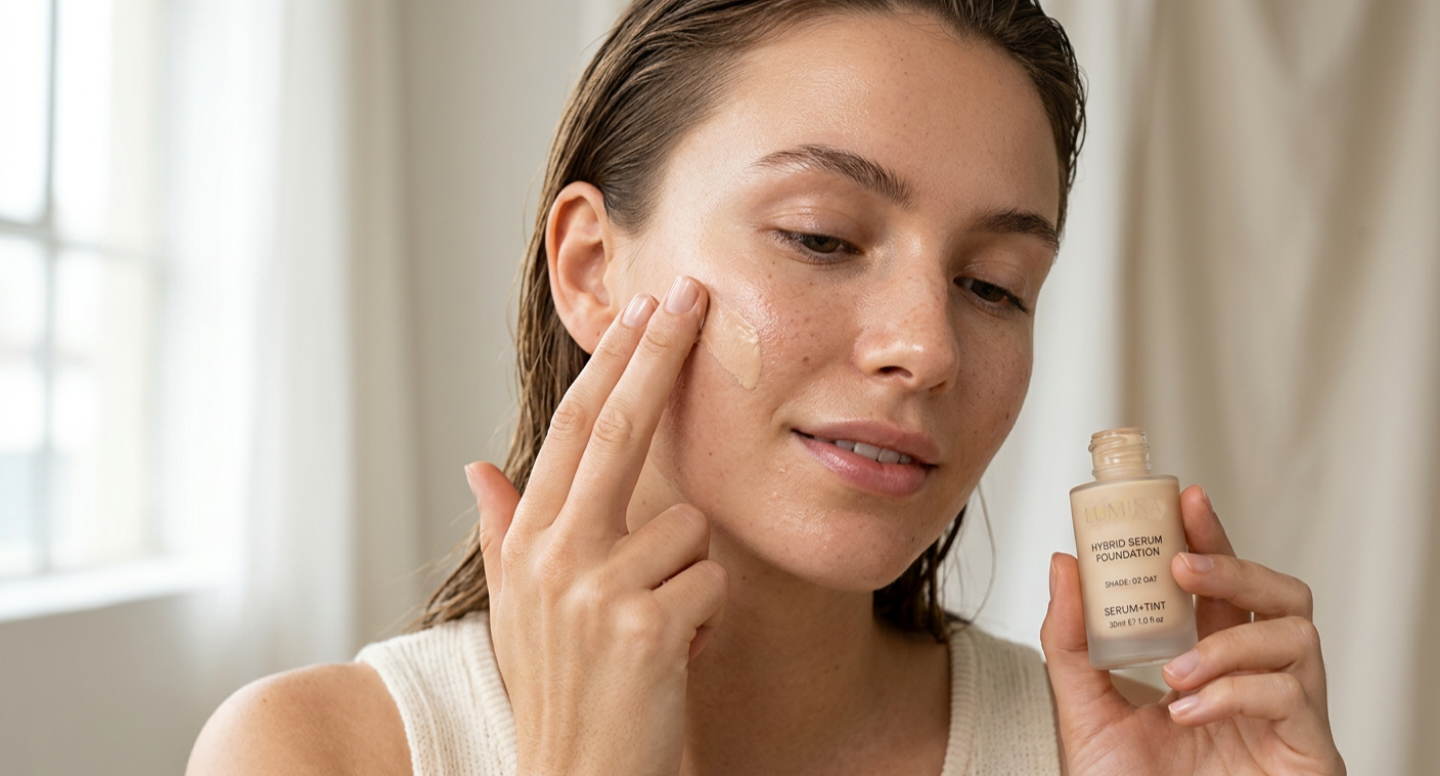
Across the beauty industry, more makeup products are being marketed with skincare-related claims. Foundations, skin tints, primers, and lip products increasingly highlight ingredients associated with hydration, skin barrier support, SPF protection, and long-term skin health.
At the same time, consumers are showing growing interest in lighter makeup, simplified routines, and products that serve multiple purposes. As a result, the line between makeup and skincare appears to be becoming less defined.
NBMakeup Analysis
1. What This Means
At first glance, this may look like a product trend. In reality, it may reflect a larger shift in consumer expectations.
For decades, makeup and skincare had different jobs. Skincare was expected to improve the condition of the skin. Makeup was expected to change how the skin looked.
Today, consumers increasingly expect a single product to do both.
A foundation is no longer judged only by coverage. A lip product is no longer judged only by color. More consumers now ask what a product does for their skin in addition to how it looks.
This changes the competitive landscape for beauty brands. Performance alone may no longer be enough. Brands are increasingly expected to deliver both aesthetic and skin-health benefits.
However, this does not necessarily mean that all makeup products will evolve into skincare products.
Many professional and performance-driven categories still depend on highly specialized formulations designed to achieve specific cosmetic results, such as maximum coverage, extreme longevity, color correction, or artistic expression.
In these cases, skincare benefits may be a welcome addition, but they are unlikely to replace the product’s primary purpose.
Rather than eliminating traditional makeup categories, the current shift may create a beauty market with two parallel paths: products designed primarily for skin health and everyday use, and products designed primarily for performance, artistry, and professional applications.
2. What Is Interesting
The interesting part is not that makeup products contain skincare ingredients.
The interesting part is why consumers want them.
For years, beauty marketing focused on transformation: covering imperfections, creating flawless skin, and changing appearance.
Today, many consumers appear more interested in maintaining healthy skin than hiding it.
This may explain why terms such as skin barrier, hydration, skin longevity, and skin health have become increasingly common in conversations that would previously have focused only on makeup.
If true, the industry may be witnessing a deeper cultural shift: beauty products are being evaluated less as tools of transformation and more as tools of maintenance and long-term care.
3. What Remains Unclear
Several questions remain unanswered.
Can hybrid products deliver meaningful skincare benefits, or are some claims primarily marketing-driven?
Will consumers continue prioritizing multi-functional products during economic uncertainty, or return to specialized products?
And perhaps most importantly:
If every makeup product becomes a skincare product, will consumers eventually stop viewing them as separate categories altogether?
The answer could influence how future beauty brands are built, marketed, and positioned.
NBMakeup Verdict
The story is not that makeup is becoming skincare.
The more important possibility is that consumers may no longer see a reason to separate the two.
For decades, beauty products were organized around categories. The next phase of the industry may be organized around outcomes instead.
Consumers do not necessarily want “makeup” or “skincare.” Increasingly, they appear to want healthy-looking skin, and they may care less about which category delivers it.
Source :
- Industry trend observation
- Beauty market behavior analysis


No comment