
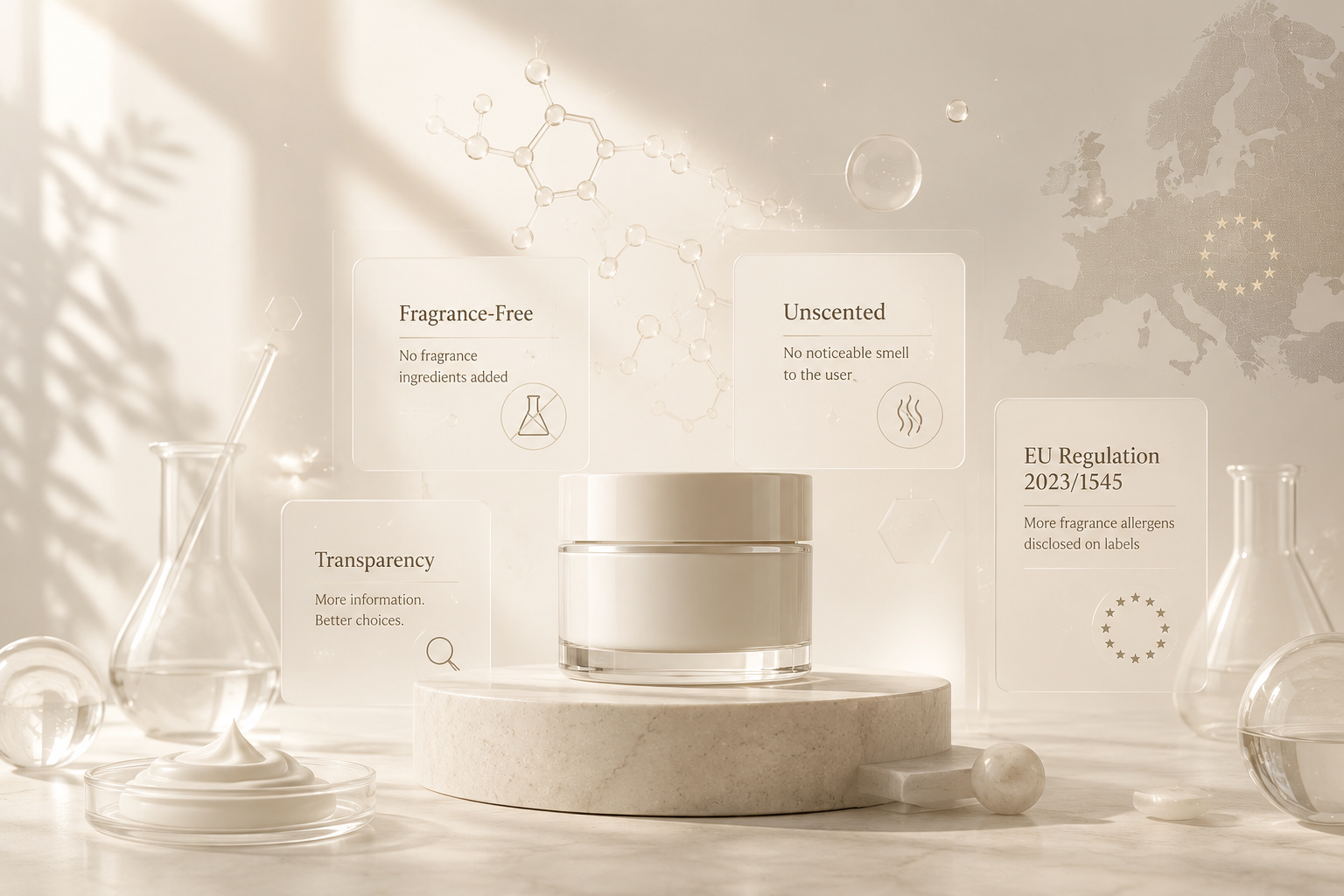
If you’ve shopped for skincare, you’ve probably seen labels like “fragrance-free” and “unscented” and assumed they mean the same thing. They don’t — and the difference has become more relevant this year because of a new European Union regulation expanding fragrance allergen disclosure requirements for cosmetic products. By July 31, 2026, many products sold in the EU will need to list more detailed information about fragrance allergens on their labels.
That might sound like a narrow regulatory update, but it raises a real question: if consumers already rely on claims like “fragrance-free” and “unscented” to make decisions, why are regulators now asking brands to disclose more fragrance ingredients rather than fewer? The answer starts with what those two labels actually mean — and where the gap between them comes from.
Fragrance-Free vs. Unscented: What’s the Difference?
Fragrance-free generally means fragrance ingredients haven’t been added to create or change a product’s smell. That doesn’t mean the product has zero odor, though — some raw ingredients, like plant oils or certain active ingredients, carry a mild natural scent of their own even when nothing has been added specifically for fragrance.
Unscented means the finished product has no noticeable smell to the user. But that result can be achieved two different ways: either the product genuinely contains no fragrance ingredients, or it contains something added specifically to mask or neutralize the smell of other ingredients. This second route is where the confusion — and the potential risk — begins. An unscented product can still contain fragrance-related chemicals if those chemicals are being used to hide an odor rather than add one. For most consumers that distinction won’t matter much. For someone with fragrance sensitivity, eczema, rosacea, or a diagnosed fragrance allergy, it can matter quite a bit, because their skin reacts to the chemical itself, not to whether the brand intended it as a “scent.”
Why Is Europe Changing the Rules?
The core problem regulators are responding to is a labeling gap: in many markets, a product can contain a complex blend of dozens of fragrance compounds while the ingredient list shows only the single word “fragrance.” That single word protects the formula as a trade secret, but it also means a consumer has no way to know which specific substances are actually in the bottle — including ones they might personally react to.
The EU has been narrowing that gap for years. Previously, brands had to name 24 specific fragrance allergens on the label once those substances passed certain concentration thresholds. Under Regulation (EU) 2023/1545, that list grows from 24 to roughly 80 named substances. In practice, this means EU consumers will start seeing more individual fragrance ingredients spelled out on packaging, rather than folded into the generic word “fragrance.”
What Does This Mean for Beauty Brands?
The new rules don’t ban fragrance — they require more disclosure about what’s in it. For brands selling into the EU, that means reviewing formulations, checking which of the newly listed allergens they use, and updating labels ahead of the deadline. For consumers, it means the ingredient list becomes a more reliable source of information than it currently is, since more of what’s actually in the product will be named rather than grouped under one umbrella term. The regulatory focus, in other words, isn’t on eliminating fragrance from cosmetics — it’s on making fragrance ingredients identifiable.
Does “Fragrance-Free” Mean Better?
Not necessarily, and this is where skincare discussions often get oversimplified. Some consumers assume all fragrance is harmful; others assume natural fragrance ingredients are automatically safer than synthetic ones. Neither assumption holds up consistently, because individual sensitivity depends on the specific compound and the person — not on whether that compound came from a lab or a plant. A naturally derived ingredient like an essential oil can still cause irritation or an allergic reaction in someone who’s sensitive to it, just as a synthetic fragrance compound can.
For people without known fragrance sensitivities, choosing between fragrance-free and unscented products is largely a matter of personal preference, and neither label carries much practical risk. For people with eczema, rosacea, contact dermatitis, or a diagnosed fragrance allergy, the ingredient list is more useful than the front-of-pack claim, precisely because “unscented” doesn’t guarantee the absence of fragrance-related chemicals — it only guarantees you won’t smell them.
nbmakeup Perspective
- What we find interesting: the EU isn’t regulating whether products contain fragrance — it’s regulating whether consumers can actually identify which fragrance allergens are present. That’s a subtle shift, but it reflects a broader move from marketing claims toward ingredient transparency as the basis for consumer trust.
- What remains unclear: whether most shoppers will actually use the additional disclosure. Ingredient-list literacy is uneven — some consumers read every line, while most still decide based on the front-label claim alone. More available information doesn’t automatically mean more informed decisions.
- What we’ll be watching: as the July 31, 2026 deadline approaches, whether brands change how they market fragrance-related claims, and whether the expanded disclosure measurably shifts consumer behavior — or simply adds detail that most shoppers scroll past.
Sources
- European Commission
- U.S. FDA — Fragrances in Cosmetics:
- American Academy of Dermatology — “Dermatologists’ top tips for relieving dry skin”
- Cleveland Clinic — “Tips for Getting Rid of Dry Skin on Your Face”
- Cleveland Clinic Newsroom — “Why Fragrances May Be Irritating Your Skin”
No comment