
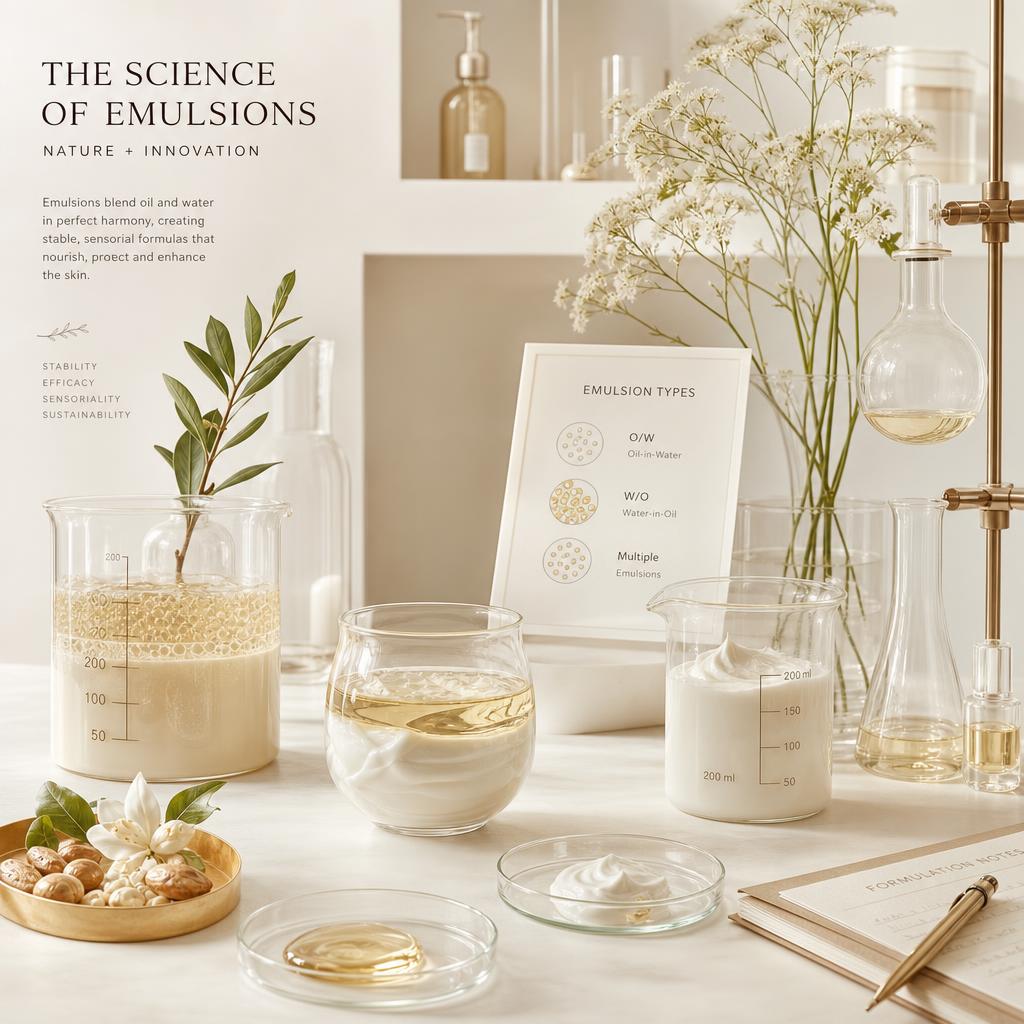
Many beauty products — including creams, lotions, and some serums — are emulsions: mixtures of oil and water that are held together by emulsifiers. Because oil and water do not naturally remain mixed, emulsions are thermodynamically unstable systems. However, when properly formulated, they can remain physically stable and perform as intended for months or even years.
Two Types of Separation — And Why the Difference Matters
Not all separation means the same thing.
Reversible separation can occur when gravity gradually causes ingredients to redistribute within a formula. Oil may rise toward the surface (creaming), or heavier particles may settle toward the bottom (sedimentation). In some products, gentle shaking or mixing can restore a uniform appearance. This type of separation does not automatically indicate spoilage or product failure.
Irreversible separation is different. One common mechanism is coalescence, where small dispersed droplets merge into larger ones over time. Once the internal structure of an emulsion is significantly disrupted, shaking may no longer restore its original texture or performance. In these cases, the product may no longer behave as originally intended.
What Influences Emulsion Stability?
Emulsion stability depends on multiple formulation and manufacturing factors working together.
One important factor is the emulsifier system. The emulsifier’s hydrophilic-lipophilic balance (HLB) must be appropriate for the type of emulsion being created. For example, oil-in-water formulations generally require different emulsifier systems than water-in-oil formulations.
However, HLB is only one part of the picture. Stability can also be affected by droplet size, viscosity, stabilizing polymers, ingredient interactions, manufacturing conditions, storage temperature, and packaging design. Because of this, emulsion stability is rarely determined by a single factor alone.
Why Some Minimal-Ingredient or “Clean Beauty” Products May Show More Visible Separation
Some products formulated around ingredient simplicity or specific “clean beauty” philosophies may use different emulsifier, stabilizer, or preservation systems than conventional formulas.
In certain cases, these choices can result in products that are more likely to show visible physical changes over time, including separation, even while remaining microbiologically safe. However, visible separation is not an inevitable characteristic of all clean beauty products, nor is it caused solely by the choice of preservative system. The outcome depends on the overall formulation strategy and how well the complete system maintains physical stability throughout the product’s shelf life.
How to Tell Normal Separation from a Potential Problem
A product showing mild, predictable separation that returns to normal after mixing is often experiencing a physical change rather than spoilage.
However, separation should be evaluated alongside other signs. Persistent separation that does not resolve after mixing, significant texture changes, unusual color shifts, package swelling, or noticeable odor changes may indicate a different issue and warrant caution.
Importantly, the absence of an unusual smell does not guarantee that a product is in perfect condition. Odor is only one indicator among several that should be considered when evaluating product quality.
The Bottom Line
Visible separation is not always a sign that a beauty product has gone bad. In many cases, it reflects the natural behavior of complex formulations containing ingredients that do not inherently remain mixed.
The key distinction is whether the separation is reversible and expected, or whether it reflects a deeper loss of structural stability that affects the product’s performance, safety, or intended use.
Sources:
Global Formulation — Emulsion Separation in Cosmetics
The Cosmetic Formulator — How to Stop Emulsions Separating
Lien M. — Phase Separation in Cream Manufacturing
BioLin Scientific — Emulsion Instability Phenomena

No comment